
Thoughts about the SEND White Paper


The SEND Consultation and the related White Paper are currently proposals about proposals: It is far from perfect and the devil will be in the detail. However, I am cautiously optimistic. This is more than a rearrangement of the deck chairs on the Titanic. It is a document with scope and ambition which recognises that reform of education, including SEND, is a long term project. It views SEND as part of a wider approach to education, not something that can be ‘fixed’ with some tinkering at the edges and changes in terminology. There is real consideration of the range of issues involved and interlinked proposals put forward in response. However, this make the SEND consultation document alone highly complex.
It covers a wide range of issues including:
· Understanding of Inclusion
· The Graduated Response
· Areas of Development
· Establishing a national system
· Funding
In this blog, I am going to pick my way through some of the key changes and ideas in the SEND consultation document. I will leave other focus on the wider issues covered in the White Paper itself.
The plan will involve a re-issued SEND Code of Practice which will in time have its own consultation process.
Inclusion
Every child deserves high-quality, inclusive education close to home, where they can learn, make friends, and participate in their community. To make that happen, we want to take the best of the SEND system and make it part of the mainstream, so that we have one education system, not two parallel ones. (Page 8)
The approach proposed in these reforms is based in inclusion. That all children should have the opportunity to attend local mainstream education. It is also rooted in equity: an understanding that not all children need the same. It, therefore, allows that some children will need the additional and different support offered through Inclusion Bases and Special Schools.
It recognises both the importance of schools becoming more accessible (and inclusive) and early intervention to understand children’s needs and shape schools’ responses to them. Each school will be required to have and to share an Inclusion Strategy Report. These will replace the now largely forgotten SEN Information Reports. Hopefully, these will be living expressions of schools’ vision and commitment to inclusion. They will be given weight by a clear link to OFSTED’s focus on Inclusion.
Creation of a national system
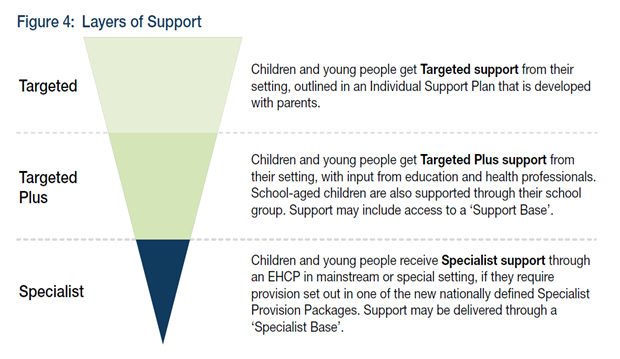
While one of the principles behind these proposals is ‘local’, the key to making this possible is a focus on national consistency and thresholds. By removing the different thresholds, paperwork and language used in different local authorities, these reforms aspire to establish a national SEND system of support. The system would be based in digital Individual Support Plans (ISPs) which could move both through the graduated response and across settings and authorities. These would be based in nationally agreed Inclusion Standards which will set out clear, evidence-based guidance for the Universal offer, as well as what Targeted, Targeted Plus and Specialist layers of support should look like across the whole 0-25 system. These should also link to resources and training, including a digital library of high-quality identification tools and provision, covering all layers of support so making it clear what good ordinarily available provision should be in every setting.
For children’s support to be able to move effectively between settings would be a huge step forward, particularly for the most vulnerable and highly mobile children and families.
The Graduated response
A graduated response remains at the root of the proposed approach to the SEND system. The layers of support are renamed and feel reminiscent of the pre-2014 system. Interestingly, the figure included in the consultation document does not include EHCP support, although they remain within the framework.
Universal Support
All SEND support should be rooted in high-quality, adaptive teaching: good teaching for those with SEND is excellent teaching for all. All children should experience calm environments, a rich and broad curriculum and engaging enrichment opportunities. We are told that the Universal offer will include:
• ambitious leadership and governance that embed inclusion in planning.
• evidence-based support prioritising early intervention.
• high-quality teaching with curriculum designed for all learners.
• accessible and enriching provision beyond the classroom.
• a safe and respectful culture fostering belonging and attendance.
• strong partnerships with families and wider services; and
• inclusive environments with continuous improvements to accessibility.
It is this provision along with the related curriculum changes that will be at the root of the success or failure of these reforms. One of the main reasons that the current SEND system is not working is because too many mainstream education settings are not inclusive or accessible for so many children. The creation of Inclusive Classrooms and schools will be key to this. There is a training budget and funding attached to this; however budget alone is unlikely to be sufficient to change the culture within schools to ensure a move away from the tight restrictions of the Gove curriculum and the zero tolerance approach epitomised by the Michaela School.
Targeted Support
This will be mainstream school based provision for children who have ongoing and commonly occurring needs which cannot typically be met by the Universal offer provided in consultation with parents. This is what the current SEN Support provision should look like but often does not. The implementation of the National Inclusion Standards should create clear thresholds- what is and is not SEND, though this in itself may be a concern if the thresholds become tick boxes that fail to recognise the diversity and cumulative impacts of children’s needs.
Further, each child will have a digital ISP which will support transitions between schools, localities and key stages. One of the current frustrations for some parents, particularly at secondary school is that their children have no paperwork or no visible paperwork to evidence or plan the support they are being given (or not). Hopefully, this will end that. The paperwork should be consistent across settings, be visible and accessible to parents, as well as school staff.
Moreover, this level of support should offer access to expertise like speech and language therapists, small group provision or adaptations to the curriculum without the need for lengthy assessments. It may include small group interventions to develop language skills, or pre-teaching key vocabulary to help access the curriculum. Currently, access to even this level of support is often dependent on an EHCP or at least an EHCP application. It should not be so. We know the earlier and quicker we can provide support the greater the impact. This may even prevent children needing higher levels of support.
Targeted Support Plus
This language does feel like the School Action and School Action Plus of the pre-2013 SEND system. Like the old School Action Plus, Targeted Plus will offer children who need ‘more specialist support to thrive in inclusive mainstream education’. This is provision within schools, supported by the so called ‘Experts at Hand’ offer (page 59) and a digital ISP. This will ensure settings can access high-quality support from education and health professionals and outreach from AP or specialist settings. It is also planned that groups of schools working together (page 91) will help deliver Targeted Plus support where it is hard for one school to do so alone.
Experts at Hand
This is a new offer of expert advice and services from education and health professionals (such as education psychologists or speech and language therapists). into mainstream education settings. It sounds like the earlier concept of multi-professional teams working around children and schools The offer should eventually include delivery guidance and examples of good practice. This needs to be the basis of support within schools. SENCos cannot and should not be expected to be the source of all SEN knowledge. They need support and access to both additional expertise and effective assessment services to support the children in their care.
This all sounds wonderful, but how it will work is another question. There are further issues of funding. £1.8 billion sounds a lot, but I have no idea how far it will go. Even more there are issues of recruitment. Where will all the EPs and Speech and Language Therapists needed to make this real come from? This is a long term plan, but so are the training programmes for these experts, assuming there are people willing and able to complete the training.
Inclusion Bases
Further, the children at Targeted Support Plus (and Specialist Support) will have access to an ‘Inclusion Base’, where required. These will be within their mainstream setting and provide high quality bespoke learning environments, equipment and expertise to meet their needs (page 55). They should combine access to the mainstream curriculum and activities – adapted where required – alongside bespoke specialist teaching and support.
Targeted Plus support may be extended by specialist support packages and could involve time-limited support in an Alternative Provision (AP) or a specialist setting, which will allow pupils a short time placement for their needs to be assessed and addressed, before reintegrating back into a mainstream setting.
It is envisioned that all secondary schools will have an inclusion base. It is less clear what will happen to those needing this level of support within primary schools. To some extent, this is planned provision catching up with the on the ground reality as more and more schools are running inclusion bases, units and classrooms. This will bring them under a single descriptor and will hopefully tackle some of the issues where these have effectively become segregated spaces providing patchy, often TA led, provision for those awaiting special school placements, EHCP assessment or otherwise not able to manage in mainstream.
Specialist Support
This is the level of support for those identified as having complex needs. There is no single definition of ‘complex needs’ which is both a strength and weakness. It does not force children and their needs to fit into particular descriptive criteria or labels, but at the same time the lack of clarity will open the issue to debate and possible legal scrutiny. It is concerning language that leads to uncertainty for parents and others.
It is planned that by sharing expertise and resources, mainstream and specialist settings will work in close partnership to provide ‘Specialist support’. This will be related to the new nationally defined ‘Specialist Provision Packages’ (SPP) (page 65) which will be designed by a national panel of experts, overseen by an independent chair, and tested with parents. It is not clear who the expert designers will be or where they will come from.
The packages of provision will outline packages of support, based on evidence. These should support teachers, educators, SENCOs and other professionals when identifying whether they think a child requires provision beyond that which the setting can provide, via the Targeted Support offer.
These nationally defined Specialist Provision Packages will include mainstream and specialist support and form the basis of an EHCP. The aim is that only children who need the overall package of support detailed in a Specialist Provision Package will be entitled to an Education, Health and Care Plan (EHCP).
It is suggested that there will be about seven of these packages. Some of which will map onto familiar descriptions of complex SEND while others will support a group of children with different, or no, diagnoses but requiring similar support dependent on need, not diagnosis. It is, for example, accepted that those with Autism may not all be supported by the same package as their needs will vary. It also recognises the difficulties presented by low incidence, highly complex needs and the need for a fast track system for a SPP and EHCP for children under 5 who have been identified as having complex needs. This would involve working closely with the NHS. The fast track will be very important to reduce the number of children with complex needs arriving in mainstream schools with little or no support and it then taking a year or more to access the support they need. This issue alone is pushing many schools to breaking point.
Each Specialist Provision Package (SPP) will include a description of the need profile. This is designed to support a more distinct offer, which is substantially different from the usual curriculum model and approach delivered in mainstream settings. It will include a plan for core educational provision and the range of additional services, interventions and resources that are needed to remove their barriers to learning, such as access to physiotherapy and augmentative communication devices.
We are also told that children will be matched to the SPP by a new Local Authority led statutory needs assessment linked to national costings. This does sound very like the current Education Health and Care Need Assessment (EHCNA) process, though with a national element which may increase the consistency between what is offered in different LAs.
EHCPs
These are not included in the layers of support diagram in the consultation document. But are clearly continuing in both the short term (there are high levels of guarantees of continuity for those already in the system) and long term. Despite the publicity to the contrary, EHCPs seem to be continuing largely unchanged, though there are aspirations that improved inclusion will mean that fewer children will need them. EHCPs will guarantee statutory entitlements to the educational provision from the Specialist Provision Package that children need and outline their expected outcomes. Local authorities will retain overall ownership of an EHCP and their duties to provide sufficient placements and resources will be strengthened. If a child is assessed as not requiring an EHCP, the LA will be expected to work with their setting to ensure appropriate support is put in place.
One of the big changes will be a standardised and digitised EHCP template which will be transferable across settings and LAs. It will aim to improve quality and consistency and be complemented by the NHS to move towards digital-first service delivery. Again the delivery of a national system would make life so much easier for so many families and professionals particularly at points of transition between localities, schools and key stages.

The day-to-day provision would be supported (as it should be now) by an ISP which would be regularly reviewed by the setting. The EHCP would be reviewed at the end of key stages by the LA. Again this should be happening now, though often does not, or not in more than a cursory manner. It would make a huge difference, particularly at the transition between primary and secondary school. This is being presented in the press as children losing their EHCPs at transition. I hope rather that it might mean that children enter secondary school with a clear understanding of their current needs rather than their needs at the time of assessment. As a secondary SENCo, it is very hard to know if and how your school can meet a child’s need from EP and Health reports that date from when they were seven or even younger. Up to date information can only promote the provision of appropriate support.
There is a helpful visual of the EHCP process on page 68.
The role of Special Schools
Although inclusion within mainstream settings is key to the whole approach within this White Paper, there is a recognition of the place of and need for Special Schools and APs. This will include a clear focus on outreach and a shift towards greater integration. Specialist settings will become centres of excellence, driving inclusive practice through outreach and partnership with mainstream settings.
Alternative Provision (AP) will offer three levels of support:
outreach to mainstream schools
short-term placements for assessment and reintegration,
longer-term placements when needed.
Local authorities will be responsible for quality assuring non-school (unregistered) Alternative Provision against new national standards.
There is also a promised update in the law for independent special schools to ensure children receive suitable, high-quality placements and that local authorities pay fair, reasonable costs for them.
This is part of a planned re-set which hopefully will see an increasingly inclusive approach and offer in mainstreams and specialist bases so that the need for specialist school placements can be reduced.
Areas of development
Oddly, this area of change has had least press coverage. The current areas of needs are being refreshed as ‘areas of development’. The idea, is very sensibly, to move away from the current system of categorisation of children which has led to an increasing reliance on diagnosis. Too often this is hiding nuance and individual differences which often inhibits schools’ ability to meet children’s needs. The idea is that the language of areas of development will support early and dynamic needs-led provision, enabling educators to recognise and respond to the educational needs that are likely to present in a classroom or setting. These can then be described in terms that they know and understand.
The areas of development are described in some, though not great, detail in Annexe D of the consultation document.

One of the biggest changes in the introduction of the areas of development is in relationship to mental health. In 2013 we moved from BESD (Behaviour, emotional, social difficulties) to SEMH (social, emotional, mental health needs) recognising that behaviour was communication of need, not a need in itself. Here is the focus shifts to social and emotional needs.
ADHD
As part of the reset of how we look at Social and Emotional needs has been to move ADHD away from the area into Executive Function. This seems a helpful clarification.
Mental health
This leaves a question about where and how support with mental health fits into the SEND system. The document accepts that, at some point in their education, many children in mainstream schools will need mental health support. These children may or may not have SEND but need support regardless. There is a focus on settings creating calm, inclusive environments, building belonging, and making reasonable adjustments. Also that schools will have an ongoing, important role in the early support and prevention of poor mental health. By expanding Mental Health Support Teams (MHSTs), the Government aims to provide access to specialist mental health professionals in every school and college. This programme has already begun its roll out.
Further for some children, their mental health need will be their only additional need. For others, setting-led support for their social and emotional needs may need to be delivered alongside clinical mental health interventions, which should be led by health professionals. It is clear that clinical mental health interventions, which should remain with health professionals, are likely to play a significant role in some of the Specialist Provision Packages.
Reasonable Adjustments
There is a clear recognition of the legal status of reasonable adjustments under the Equality Act and UN Conventions. Moreover, that children do not need a diagnosis to receive reasonable adjustments Their needs are not fixed and change over time, so that their need for adjustments may change. There is a promise of further help for settings to consider how some disabilities can be addressed at a universal level – both through high-quality teaching, and through wider aspects of school or setting policy such as uniform, behaviour and classroom management.
Multi-agency working
Implied across the SEND consultation and described in more detail within the White Paper is the role of health and other agencies in the SEND process. This again is a push towards a reset in this case that an EHCP is an education, HEALTH and CARE plan and not the sole responsibility of the education sector.
The social care role is underline in a couple of key elements:
The role of Best Start Family Hubs, including a named SEND professional, to support particularly those in Early Years and out of schools. These hubs will act as a single front door for families, making it easier to access the right help at the right time. As such they will play a vital role in identifying needs and intervening swiftly with evidence-based support (p.9). They are being allocated significant funding. Hopefully, this will rebuild the excellent work that was done by Family Centres and Sure Start under the Blair government.
There is a clear commitment to integrating education formally into new multi-agency teams, establishing schools as the fourth safeguarding partner alongside LA, police and health services (p.20). I thought that this had been abandoned as the DfE policy paper (from January 2026) setting out the expectations for Multi-agency Child Protection Teams (MACPTs) stated that schools would remain as a relevant agency. While each MACPT would include one person nominated by the local authority who has experience in education in relation to children. Further it added ‘that education is automatically, and by necessity, part of local safeguarding arrangements and that education's voice is captured in decisions about child protection priorities and practice.’ We will have to wait and see what the true policy and plan is.
There is a real commitment to the inclusion and training for those in both Early Years and post 16- education.
Schools working together.
Another key element of the multi-agency working is for schools to work together. This will include all schools being part of an academy, but that Local Authorities can have a role in the formation of these.
Beyond there are clear expectations of schools coming together in a local group. These groups will pool some funding, share resources and work together to improve and expand the help and support available to children. This includes the recognition that need is not even or predictable. This all feels a long way down the line and until we have more detailed plans rather unclear.
Funding
Along with where the experts and those to be trained at EPs, speech and language therapists and other roles are to come from, the big elephant in the room is around funding. The consultation includes lots of promises of what sounds like eye-watering amounts of money. To be honest, I have no way of knowing if the money is enough to provide what is promised or understand where in the government budget it is coming from. I suspect even for those more expert in these matters, the truth will only become clear in time. In the meantime, we need to note that there is budget and large quantities of it being promised. The DfE is not expecting to get something for nothing.
Training
Built into the consultation plans and budgetary commitments (over £200 million over 3 years) is a strong vision of training for staff working across early years, schools and Post‑16 settings to support staff to build inclusive learning environments. This will include focused training.
In Early years where training will focus on inclusive pedagogy, child development, and practical strategies for supporting all children, building on the commitments made in the Giving Every Child the Best Start in Life strategy and ensuring every setting feels confident in welcoming children with SEND.
For staff in schools training will focus on adaptive teaching and creating calm classrooms to provide the best support for their pupils. Specific training for teaching assistants will also help support inclusive practice.
Additional content in ITT and ECF.
There will be a review of the role of SENCos to ensure that they can use their expertise more strategically, as well as a review of NPQs, presumably including those for SENCos.
Clearly, the details of this training, how it will be delivered and who by is yet to be decided.
Other issues
In my view one of the strengths of the White paper and consultation document is the range of issues covered (though not all in the same depth or full clarity). This includes:
The role of parents including a framework of Parents Carer Forums and both a presumption to mainstream and a right to choose. A sub point in this and the question of placements is that that LAs will no longer be required to name a school or setting that is already full.
The status and role of tribunals. These will be a point of last resort and focus on Special education needs and provision rather than naming placements. This is a change that is seen as particularly controversial by some parents’ groups and may be so. But what we need is a clearer and fairer more inclusive system so that fewer families are forced to use this last resort.
A pupil engagement framework to support pupil voice about the system.
A focus on the use of technology including the use of digital ISP and EHCP paperwork, but also assistive technology lending libraries and training. The systems will also allow tracking of children across the education system including challenging off-rolling and children disappearing within the system.
There is a clear link with both the OFSTED and CQC inspection processes. Schools and settings will be required to demonstrate that they are inclusive and show how they support children with SEND linked to the National Inclusion Standards.
Some passing consideration of the role of the SENCO and an anticipation that the role will become more strategic and less administrative is included. But this is not explored.
Concluding thoughts
This does all feel rather overwhelming, but it is evidence that these issues have been thought about and many of them are interlinked which demonstrates an understanding that this is not simple and can’t be fixed quickly. There is a need for whole system change.
Change on this level is frightening and unsettling, particularly for the parents of children most closely engaged in it. This is made worse by a lack of trust in government to make and manage effective change. Further, there are fears that change might be started and not followed through, not meet expectation or worst of all be abandoned due to a government change and resulting political volte face. In reality, there are substantial safeguards for those already within the system which both aims to provide reassurance and recognises the importance of continuity for these children (and parents). I am not sure, given the headlines, how successful this strategy to build trust has been. But we need to remember that these are proposals about proposals and not immediate law changes as much of the media appears to suggest.
What is clear is that the present system is not working. It is in effect reversing the vision of inclusive education with the vast majority of children being taught in a mainstream setting first set out in the Warnock Report in1978. It continues to be based on all SEN Support children being supported with a notional £6K which has not been reviewed or updated since 2013. This inadequate core funding continues to undermine the entire system, leading to the push for additional funding which is being eaten up by tribunal costs, private special schools and an inflexible system which risks children without EHCPs getting lost every time they move school.
We need:
more inclusion and accessibility in our schools.
an understanding that all children, even those with the same diagnosis, do not have the same needs.
a re-balance from ‘top-up’ funding and EHCPs to core funding and provision
access to early intervention that is not dependent on a diagnosis.
a reduction in the current adversarial and bureaucratic system. This will be helped by clear guidelines and more consistent support, hopefully reducing the requirement for schools and parents to push to get children’s basic needs met.
There are elements of all of this in the consultation. What the final changes are is in the future, but holding on to a failing system for fear of something worse will solve nothing. We need to engage with the consultation and hope that confidence and trust in the SEND system can be rebuilt.


Bài viết có nhiều thông tin đáng tham khảo và cách diễn đạt khá dễ hiểu. Mình thích việc tác giả tập trung vào nội dung chính thay vì sử dụng quá nhiều câu chữ không cần thiết. Những người quan tâm đến xổ số miền bắc có thể dễ dàng theo dõi và tìm được thông tin phù hợp trong bài.
hi
The discussion surrounding the SEND White Paper and the necessity of inclusive educational frameworks is deeply compelling, particularly as it touches on the psychological impact of structural support or the lack thereof which I often reflect upon while navigating the intensive rigors of my current PhD research. Balancing my doctoral studies with a part-time role at last minute assignments has given me a front-row seat to the modern student experience, where navigating complex educational needs often clashes with overwhelming deadlines and the mental pressure to perform; having suffered through many high-stress hustles and sleepless nights during my own college days, I am now incredibly conscious of the mental toll that an unmanaged workload can take on one’s stability. This personal…